

A Prodigy in Waiting
LATEST STORIES

Karen Nelson’s journey to becoming a world-class athlete was anything but pure serendipity. A name now etched in the annals of Olympic history, Karen participated in the 100-meter hurdles and long-jump competitions at the 1984 Summer Olympics in Los Angeles. Karen was a seven-time gold medalist at the Ontario Federation of School Athletic Associations (OFSAA) provincial championships in hurdles and long jump; she still holds many regional records from high school competitions. A former Canadian Junior and Senior national long jump record holder, Karen is a six-time senior national champion, the Canada Games national champion in both hurdles and long jump and placed fourth at the 1982 Commonwealth Games in the 100-metre hurdles. A five-time NCAA all-American at the University of Texas, she was named to the Southwest Conference all-decade team for the 1980s as a twelve-time conference champion. Karen’s story is about self-discovery and being discovered – a diamond in the rough. Karen uncovered her hidden potential and transformed herself into something extraordinary. Her story is about growth, resilience, and realizing one’s worth. From a quiet and awkward teenager to international acclaim, Karen’s path demonstrates that greatness is forged in the crucible of adversity.
Residing in Austin, Texas, United States, Karen agreed to an interview about her Olympic journey, track and field legacies and her enduring injuries that sidelined her from amateur sports. The interview format was a series of open-ended questions to solicit candid responses. The interview provided insight into the genesis of her track and field career, contrasted her intramural, interscholastic and amateur sports contributions, and revealed the intersection of personal and professional struggles, accomplishments and lessons learned.
***
Adorned in a pastel-blue and white Nike tracksuit and seated in a recliner located in her living room, Karen appeared on screen via Skype, beaming with excitement. “Mr. Bailey”, she greeted, “good afternoon, and how are you doing”? Great, I added. As we indulged in the customary exchange of pleasantries, witty banters on families, friends and acquaintances.
Born and raised in Kingston, Jamaica, Karen is the second of three girls. Karen immigrated to Canada at the early age of seven years old. She grew up in a modest household in downtown Toronto before moving to the suburb of Durham. From the onset of purchasing their house in Durham, the family faced an insidious obstacle: the skepticism of those around them. The only black family in a predominantly white, rural community, the family felt unwelcome. The girls often felt the sting of doubt and low expectations, as whispers of them being uppity and pompous – acting as if the a best then other. Determined to protect the girls from such negative gossip, rumours and vitriol, their mother, Vivette, forbade the girls from playing outdoors. The girls were given fifteen minutes to be home after school, with no exceptions. Sports weren’t a staple in their family life; Vivette’s emphasis was on strong academic rigour. The girls’ spare time was spent doing homework or assisting their grandmother at home. As the matriarch of the family, Vivette rules the household with an iron fist. Tasked with specific chores, the girls had to ensure their chores were completed before Vivette got home.
The sole proprietor of several small businesses throughout the Durham region, Vivette was constantly on the go, checking in on the girls while transitioning between businesses. While at home, she would administer her special brand of justice if anyone violated her many rules. The girl’s grandmother, Auntie, was always at home, baking special Jamaican treats. Auntie would entertain the girls and keep them grounded in their Jamaican roots, often with folk songs, music and storytelling, while preparing their favourite Jamaican delicacies. Occasionally, Auntie would need someone to go to the store and pick up a few items. “I enjoyed running errands for my grandmother, Karen recalled. “I would run to the stores and back, often competing with other kids in the neighbourhood. However, despite my small stature, the older kids never let me win. Refusing to lose, I would push myself to the limit, that’s when I developed a passion for running”.
Career of Excellence
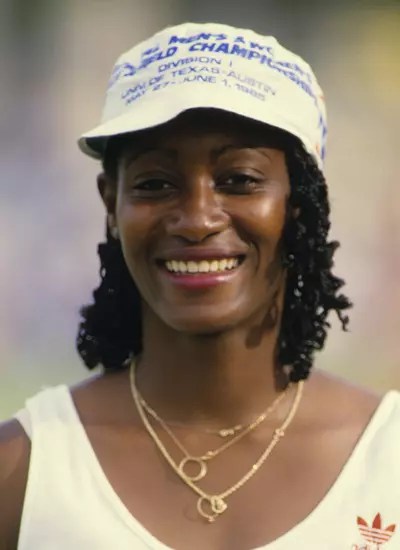
Karen’s natural athleticism was evident from an early age. By the time she entered middle school, Karen was outrunning everyone in her class, boys included. Her teachers at the middle school pleaded with her to take a more active role in sports. Reluctantly, Karen would participate in events on rare occasions, leaving everyone in awe. Despite wavering on occasion, Karen declined most invitations. At Donavon High School, her gym teacher was the first to notice Karen’s potential. He became aware of Karen’s natural prowess in running during one of her rare occasions. He pleaded with her to join the basketball team, saying, “This is a good way of getting involved in sports”. Again, Karen declined the invitation, citing her mother’s rule. When discussing Karen’s potential, her gym teacher would say, “Karen was like lightning on the track. She possesses a natural ability to run, but would never try out for any sports. But more than her speed, it was her determination that stood out. She always wanted to be better than she was the day before.”
As fate would have it, Donavon High School needed a new math teacher and a coach. Consequently, Curtis Sahadath was transferred to Donovan High School as the new math teacher. And months later, he became the track and field coach. Aware of Karen’s talent and her refusal to join the team. It was later discovered that he orchestrated several secret events to assess Karen’s ability. And after months of evaluating her in sprint and long-distance events, he was satisfied with his assessment. So much so that he wanted to assess her ability on the hurdles. Mr. Sahadath orchestrated several hurdle events using older students, both boys and girls, as props to create a competitive environment for Karen to compete in. Having completed the hurdles in record time, Mr. Sahadath told Karen, “I want you on the track and field team.” And later that day, he approached Karen’s mother and pleaded with her to have Karen join the track and field team. Karen recalled Mr. Sahadath pleaded, “Miss Smith, we believe Karen has the potential to be great at track and field if given the opportunity. We are here to present her with that opportunity, and we need her on the team”. Unbeknownst to Miss Smith, Karen’s natural ability to run, she refused Mr. Sahadath’s invitation and asked him not to return to her house. Refusing to accept no for an answer, Mr. Sahadath pleaded with Miss Smith for months, often showing up at the house unexpectedly. “Becoming extremely frustrated with Mr. Sahadath, Mom reluctantly said, ‘Yes,” and that’s how it started,” Karen said.
From that day onwards, Karen’s high school years were marked by relentless training. Conditioning programs involved not only track and field, but also volleyball, basketball and any other sports offered at Donavon High School. “Coach Sahadath insisted that I get accustomed to rigorous training,” Karen added. “As this was your first time doing organized sports”. Karen joined the track and field team as a sprinter and immediately excelled in the 100-meter dash. Her breakthrough came during her junior year of high school when she qualified for the regional championships. Not only did she win the 100-meter hurdles, but she also surprised everyone by claiming victory in the long jump—a secondary event she had taken up on a whim. But it was the hurdles event, which she discovered almost by accident, that would come to define her career. “Despite my small stature, I was able to clear the hurdles much faster than anyone else, Karen recalled. “Something about the hurdles just clicked. The rhythm, the precision—it was like a dance. A dance to Reggae Music.”
In a quick session, Karen became an integral member of the Donavon High School track and field team, shattering former record holders at school and setting new records of her own. Forty-five years later, Karen still holds several unbroken records at Donavon High School. “While at Donavon High School, we won several local, regional and national competitions, including the OMA (Ontario Masters Association) OFSAA Track & Field Championship in sprints, relays and field competitions, Karen said gleefully.
In ninth grade, Karen made the Ontario Provincial Team. By tenth grade, she was on the Canadian Junior Team. Despite being on the Canadian Junior Team, Karen was competing at the senior level against opponents who were much older than she was. Giving her an advantage with her time scores and wins, be it hurdles, long jump, triple jump and 4×100 meter relays. “These time scores were reflected in both the Juniors and the Seniors competitions, added Karen. “This often resulted in my qualification to participate in both Junior and Senior competitions.”
As Karen shattered records, college recruiters took notice. And by the time she graduated from high school in 1982, Karen had a full scholarship to York University. University brought new challenges, and the level of competition was far higher than anything Karen had faced before. However, under the guidance of a dedicated coach at York University, Karen began to refine her technique in both hurdles and the long jump. Her training regimen became gruelling—early morning sprints, weightlifting sessions, and endless drills to perfect her form. “It wasn’t just about physical training,” Karen said. “I had to train my mind to believe I could compete with the best.”During her first year at York University, Karen was not only competing with the best but also beating them. Karen competed in the 100-meter hurdles, long jump, and the 4X100-meter relay competitions, shattering records in all three events. To date, Karen is still the record holder in hurdles and long jump at York University.
Sitting upright in the recliner, Karen swivelled side to side holding a large framed picture to her chest. She talked fondly about her major accomplishments and events she had participated in on the world stage with a sense of nostalgia and wistful feelings. “Walking into the stadium for the first time was surreal,” Karen added. “I kept thinking, OMG! (Oh my God) ‘How did I get here?’ The scale of this event is overwhelming. But I reminded myself of all the hard work I’d put in, and I knew I deserved to be there.” Karen’s first international appearance was in 1980 at the Seiko Golden Grand Prix, Junior Championship, a prestigious athletic meet held annually in Tokyo, Japan, attracting top athletes from around the world. It was known for its high-level competition and exciting atmosphere.
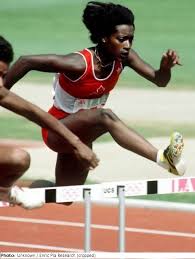
In her debut, Karen competed in the 100-meter hurdles and the long jump—a rare feat for any athlete. However, Karen won both events, the hurdles and long jump competitions, setting a record in the long jump. Anecdotally, Karen said, “Interestingly enough, I was scheduled to participate in the European track meet with the Canadian Senior Team and not the Juniors’ Championship in Japan. However, the junior athlete that was scheduled to participate was unable to attend due to visa requirements, so at the last minute, I was told I had to replace her.’ Running as a junior, Karen set a world record that lasted for years. Leaning over to adjust her seating, the large framed picture Karen clutches to her chest reveals a younger version of her standing at the podium receiving a gold medal. ‘That’s a great picture, I added. “Yes, it is, Karen said. “This one is rare and dear to my heart”.
Facing Adversity
With a growing reputation in the hurdles and long-jumper competitions, Karen was forced to do more to increase Canada’s medal standing. She was not only competing in the 100-meter hurdles and long jump but also the triple jump and 4×100-meter relays with little or no rest time between events. Adjusting her seat again, Karen said, “I was the only athlete participating on both the Canadian Junior and Senior teams. And I was participating in back-to-back events with little or no rest time, which ultimately took a toll on my overall performance”.
Karen cited the following events where her performance was less than stellar, starting with the 1981 World Championship Games held in Helsinki, Finland. Karen competed in the hurdles and long-jump competitions for both the Junior and Senior teams. She made it to the quarter-finals in hurdles and the finals in the long jump, but couldn’t compete due to insufficient rest and scheduling conflicts with the hurdles. At the Commonwealth Games in Melbourne, Australia, in 1982, Karen placed fourth with an identical time as the third-place holder in the hurdles, a result that can be attributed to insufficient rest and poor scheduling. Again, Karen was also unable to participate in the finals of the long jump competition, due to another issue of insufficient rest and poor scheduling. In the 1983 Pam American Games in Caracas, Venezuela, the protracted issue of back-to-back events resulted in Karen placing second in the long jump and fourth in the hurdles. After gruelling back-to-back events, Karen ran lead-off on the 4×100 relay team that finished 3rd.
Enduring Injuries
With a sombre tone, Karen lamented the challenges and injuries she endured from 1983 to 1989 as a result of over-entending herself. “I participated in too many events and did not have enough rest in between. I think that may have contributed to my injuries”, Karen said. “I was always doing four or more events, the long jump, triple jump, 100-meter hurdles and 4×100 relays, and at times, for both the Junior and Senior teams”. She added, “I had to do the jumps in the morning, sprints in the afternoon for qualifications and finals on the same day. Often qualified for multiple events, but only participated in one. My favourite event back then was the long jump, but I was unable to compete in it half the time,”.
In 1983, Karen competed in the World Championship Games in Rome, Italy. She ran two heats for qualification before pulling her hamstring. The injury resulted in Karen being out of commission for the remainder of the year. The 1984 Summer Olympics held in Los Angeles, USA, Karen ran two rounds in the hurdles and one round in the long-jump qualification, pulling her hamstring again. At the World University Games in Stuttgart, Germany, in 1985, Karen placed third in the 100-meter hurdles, ran two rounds in the 4×100 relays and failed to compete in the long jump due to appendicitis. Karen was rushed to the hospital, where she spent three days after surgery before flying back home. At the 1986 Commonwealth Games in Auckland, New Zealand, Karen tore her hamstring in the finals of the hurdles competition. The test result showed a curvature in her lower spine, causing severe pressure on her hamstrings. “My whole world fell apart,” Karen added. “I was devastated, I felt as if I was in mourning,”. I wanted nothing to do with the sports. This was a low point in my life”. But after months of feeling depressed and deflated, Karen decided to stop the pity party and embrace a new chapter. And in 1987, she started the triple jump in college and participated in several meets. By 1988, Karen qualified for the Summer Olympic Games in Seoul, South Korea. Later that year, she had to undergo knee surgery due to a triple jump and was not able to rehabilitate in time to compete. After several injuries throughout her athletic career and extensive recovery time, Karen retired from amateur competition in 1989.
The interview was marked by a moment of silence. Karen placed the framed picture on the tilted floor beside her. Rested her head backwards on the recliner and looked up at the ceiling, in what appeared to be her masking the pain inside. “Sadly, I had more success during collegiate sports than all international competitions combined.” Karen said, “Had it not been for all the bullshit during my amateur years, I could have accomplished so much more’’.
The Next Chapter
During Karen’s freshman year at the University of Texas, she came second in the long jump, her first time competing after retiring from amateur Sports. “Since that day, I never lost a conference long jump and hurdles event in my entire collegiate years,” Karen said. At the NCWA Championship held in Indianapolis, the University of Texas women’s team became the first female college team in history to win a trifecta: indoor, outdoor and cross-country track and field competitions, with an unbeaten record that lasted until 2020. To top things off, they won the Conference Championship five consecutive times, all attributed to Karen’s efforts.
Speaking freely about the pressure to compete and stay competitive, Karen said, “I learned early in my career that there was a certain level of discipline required to perform at the top-tiered level and sustain longevity. And that most races were won or lost based on the athlete’s psychology in the game. Therefore, to stay ahead of the competition, I needed to work on my mental acuity and manage the pressure to stay competitive”.
Karen developed a system that became a ritual. She would ensure she slept for twenty-four hours before each competition, with regular meditations and visualizations throughout the day. These routine exercises ultimately gave her the ability to mentally block things that were deemed problematic. Karen recalled a period in her career when she was extremely stressed; it happened the first time she won the National Senior Championship race. “I felt a sense of pressure for the first time, not from my peers or anyone else but from internal conflicts that cause stress.” Karen said, “Knowing that the win came with a certain expectation, I would now have to live up to that expectation. And if I didn’t win, I would be perceived as a failure or disappointment”. Karen had to constantly remind herself she was a Junior competing against Senior athletes and world record holders. Once she was able to do that, Karen won more races and enjoyed the experience of it all.
Life After Competition
For many athletes, the transition to life after competition can be daunting. The struggle to remain relevant, the loss of one’s identity, and the feelings of depression due to social isolation can be challenging at best. But Karen approached this chapter of her life with the same determination that had fueled her athletic career. She returned to the University of Texas, her alma mater, where she helped in the development of the next generation of athletes. And developed programs to create awareness and combat the pitfalls of athletes overextending themselves. “I saw so much potential in these athletes,” Karen said. “But they didn’t always have the resources or the confidence to pursue their dreams. I wanted to change that.” Today, Karen is remembered not just for her athletic accomplishments but for her impact off the track. She established a foundation to provide resources and training opportunities for aspiring athletes in underserved communities. Her story continues to inspire, a reminder that talent can emerge from the unlikeliest of places and that perseverance can overcome even the steepest hurdles.
The Heart of a Champion
Reflecting on her journey, Karen often emphasizes the importance of gratitude. “Every obstacle I faced, every setback—it all shaped me into the person I am today,” she said. “The medals are great, but the real reward is knowing I gave everything I had.”. In a world obsessed with instant success, Karen Nelson’s story is a powerful reminder of the value of hard work, resilience, and the courage to dream big. Whether soaring through the air in a long jump or clearing hurdles with precision and grace, Karen’s legacy is one of unrelenting determination—a true Olympian in every sense of the word.
Subscribe
Sign up for a weekly newsletter with the latest blog posts and exclusive content. In your inbox every Tuesday!
